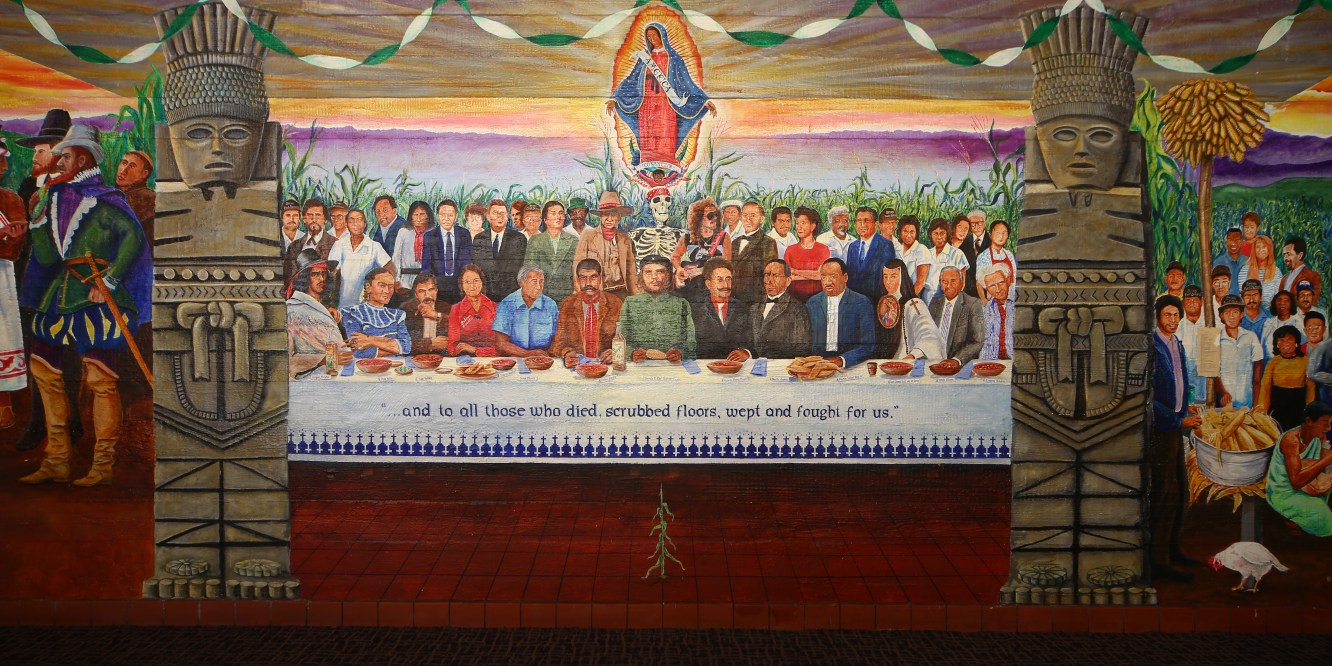
Jose Antonio Burciaga, Zapata Dining Hall, center wall (1989)
In the center wall of the mural, the artist turns from mythology to history beginning with an image of Cortez and his army. The largest piece in the three walled mural triptych stands out as its most provocative as well as most reflective of the generations students and staff living and working in the residence. This scene, “The Last Supper of Chicano Heroes” depicts political leaders, artists, and writers from different eras eating tortillas de maíz. Scattered in the background and clustered in the foreground are portraits of the artist’s friends, colleagues, and family, including Stanford food service workers preparing tortillas.
In an informal survey the artist polled 100 Chicanos at Stanford University and 100 Chicano activists from the late 1960s to find out whom they considered the top 13 Chicano heroes. Quoting the artist, “The idea arose from a mural that I was designing on the mythology and history of maiz (corn). I had intended to depict the Last Supper; Christ and his 12 apostles were to be portrayed dining on tortillas, tamales and tequila instead of bread and wine. I dropped that idea when some students expressed dismay at my mixing humor with religion. That’s when I decided to replace the religious figures with 13 Chicano heroes.” (Los Angeles Times, 1988)
Notably, the historical figure of Che Guevara sits at the center of the table.
Burciaga describes the results of his poll,”The survey was received positively –there was a 70% return –and also as a novelty. Essentially, the ultimate 13 Chicano heroes reflected the choice of the older activists because their votes were concentrated on a smaller group of heroes who had played important parts in the Chicano movement as activists or symbolic historical figures. The students were more inclusive, and offered a total of 240 hero candidates. The selection process brought into question the very definition of a hero or heroine as a mythical, historical, symbolic, military or popular culture figure. The first historical Chicano hero, according to some, was General Ignacio Zaragoza, born in Seguin, Texas, when Texas was part of Mexico. Zaragoza rose to command the ragtag Mexican army unit that defeated the French in Puebla on Cinco de Mayo, 1862. At that time the French army of Napoleon III was the most powerful in the world. But Zaragoza did not make the final list. One who did was a man who preceded him both in time andin popular lore, the Californio rebel and bandit, Joaquin Murrieta. Three living Chicanos who started their careers together made the list: César Chavez, Dolores Huerta and Luís Valdez. La Virgen de Guadalupe, patroness of Mexico, received enough votes to sit at the table, but out of respect instead occupies a loftier place. In a history mobbed with machos, there was sincere effort to vote not only for women like painter Frida Kahlo and poet Sor Juana Inez de la Cruz but also for mothers and grandmothers. Not all the heroes had to be Chicano –that is, of Mexican roots; thus Argentine-born Cuban hero Che Guevara made the list. The martyred Che, a strong symbol during the Chicano movement of the late ‘60s, occupies the central position. At his side will be the Mexican revolutionary, Emiliano Zapata.”
By Jose Antonio Burciaga, reprinted from a brochure describing the Last Supper of Chicano Heroes and Mythology of Maiz.
 Casa Zapata Mural History Project